
Most Supplements Are Just Repackaged Industrial Waste

The $20 Bottle That’s Full of Lies
What if I told you that your multivitamin isn’t the nutritional safety net you thought it was? The tiny pill with big promises isn’t really made of whole fruits and vegetables.
What if that pill you take each day is closer to something from a pharmaceutical lab than a garden?
Because the truth is, most multivitamins are made from petroleum solvents, coal tar, acetone, industrial byproducts, and rocks.
Per FTC guidelines, please assume links on this newsletter may be affiliate links that benefit us, though if so, the price is not marked up. Thank you for supporting our mission.
When Supplements Went Industrial
You might be surprised to know that the very same companies that make chemotherapy drugs and fertilizers also make your “vitamins.”
The base materials of your vitamins often come from waste streams—whatever’s cheap and abundant.
The lumber industry’s sawdust becomes cellulose (a “filler”).
Ore mining leftovers become “minerals.”
Petrochemical solvents are used to extract “nutrients.”
Then everything’s bleached, blended, and pressed into the snow-white pills we think are “pure” and “clean.”
It’s profitable. It’s efficient. And it’s perfectly legal.
The Ugly Truth About Vitamins
So now let’s look at what’s really behind those scientific-sounding “vitamin” names:
Vitamin A: Created from acetone and processed palm oil—not from carrots.
Vitamin B1, B2, B3: Made from coal tar, ammonia, and formaldehyde.
Vitamin B12 (cyanocobalamin): A synthetic compound combining cobalt (a heavy metal) and cyanide.
Vitamin C (ascorbic acid): Usually a GMO-corn byproduct processed with acetone or isopropyl alcohol.
Vitamin D (cholecalciferol): Derived from the grease in sheep’s wool or lab-grown algae, processed through five chemical steps.
Folic acid (B9): A petroleum-based toxic imitation of the natural folate found in leafy greens.
Would you give your family any of this—if it didn’t come in a pretty bottle labeled “vitamin”?
Does The Math Add Up?
Now, let’s consider your vitamin C supplement.
A bottle of “1,000 mg” tablets costs maybe $50 for 250 servings—that’s 20 cents a pill.
If that were really the concentrated nutrition of ten oranges, you’d be getting $10 worth of fruit for 20 cents, in a tiny white pill.
Plus, when was the last time you saw a white orange?
If vitamin C pills were actually made from food, they’d be orange. And they’d cost as much as food does, but they don’t.
Make sure to read Take Daily: How Supplements Hijack Our Health. I spent hours educating my co-author, Mike, who has never taken supplements–and then he went off to research, and his mind was blown.
The “Science” Behind Your Supplements
We’ve been trained to think if something has a science-y name, it’s good for us and we can trust its quality. Pyridoxine sounds smarter than banana, doesn’t it?
We read “cholecalciferol” and assume, “That must be the real vitamin D.” It’s not.
It’s an industrial replica that mimics one molecule of a vitamin found in nature—but none of the cofactors, enzymes, or living synergy that make food-based nutrients work in your body.
The supplement industry knows this. But why tell you, when the illusion sells so well?
How do they get away with it? Well, they’ve been doing it for so long, and no one’s stopped them.
My Wake-Up Call: A Bag of Solvents
After two decades of eating clean, detoxing twice a year, and taking more supplements than most people take in a lifetime—I finally put my faith to the test.
During a detox retreat at the Swiss Mountain Clinic in 2024, I underwent INUSpheresis, a medical filtration that removes metals and chemicals from the blood.
The result: nearly a quart of shimmering waste—full of solvents and residues—filtered out of my bloodstream.
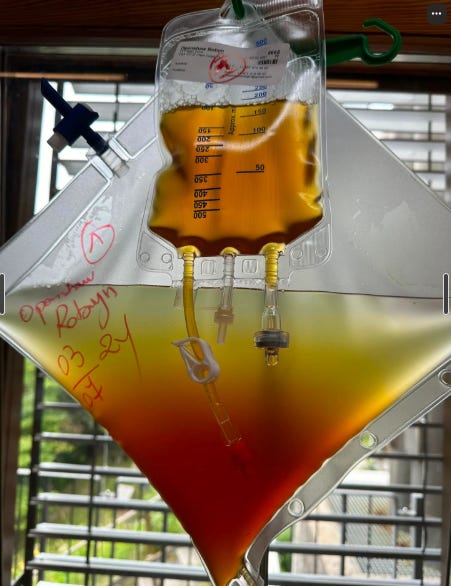
I was stunned. I eat a 95% organic diet. I don’t take pharmaceuticals. So where did all that come from?
The answer, in hindsight, was obvious: decades of “health supplements.” Solvents are involved in virtually all of them. Most solvents are petrochemical-based.
The Supplement Hype
Multiple large-scale studies show that multivitamins don’t prevent disease, extend life, or improve health.
A 2013 Annals of Internal Medicine editorial titled “Enough Is Enough: Stop Wasting Money on Vitamin and Mineral Supplements” analyzed data from hundreds of thousands of people.
Its conclusion:
“Multivitamins do not reduce the risk for heart disease, cancer, cognitive decline, or early death.”
In fact, daily supplement users had a 4% higher mortality risk than non-users.
Yes—higher.
Sometimes the data is much, much worse than that, including being linked to higher risk of cancer and all-cause mortality. Don’t miss the chapter on “Vitamin A” and “beta carotene” in Take Daily.
Trace Amounts of Toxins Are Not Safe
Supplement manufacturers like to say that “trace amounts” of heavy metals or solvents are harmless.
But whose idea of “acceptable” are we trusting?
The FDA’s own “acceptable limits” for contaminants are based on incomplete data—and the FDA doesn’t test supplements before they’re sold.
Meanwhile, thousands of small “brands” simply white-label the same formulations from the same chemical factories, changing only the label design and influencer endorsement.
Why Whole Foods Are Best
Your body doesn’t crave “isolates.” It craves synergy. It doesn’t recognize cyanocobalamin (falsely called “Vitamin B12)—it recognizes food. It doesn’t need 1,000 milligrams of anything—it needs whole foods.
Whole foods already contain vitamins in perfect proportions, wrapped in fiber, enzymes, and color.
That orange, carrot, or beet knows how to nourish you in ways no capsule can mimic.
Time To Do The Homework
Tonight, go to your cabinet. Pick one supplement. Type one ingredient into a search engine with the words:
“Chemical processes used to manufacture [ingredient name].”
Read what you find.
Then ask yourself: would you eat that if it hadn’t been sold to you by someone you believe knows more than you do, about your health? With a healthy-looking label?
Some Closing Thoughts
The multivitamin myth is one of the most expensive illusions in modern health.
The same companies that sold us “safe and effective” drugs are now selling us “natural and essential” vitamins—using the same factories, solvents, and marketing playbooks.
It’s time to trade the capsule for a carrot. The bottle for a blender. And the false narrative for the truth.
Thanks for subscribing to my Substack blog post! We especially appreciate those of you who contribute $10/mo, if my work impacts your life positively.
It does not matter what the starting materials are, the final chemical is the same whether it's from Mother Nature or Uncle Pfizer:
https://thescamdoctor.substack.com/p/you-have-no-idea-whats-toxic-how?r=6hgshq
While true there are supplements that are the real deal. To assist in this use AI to secure purity. Just saying.